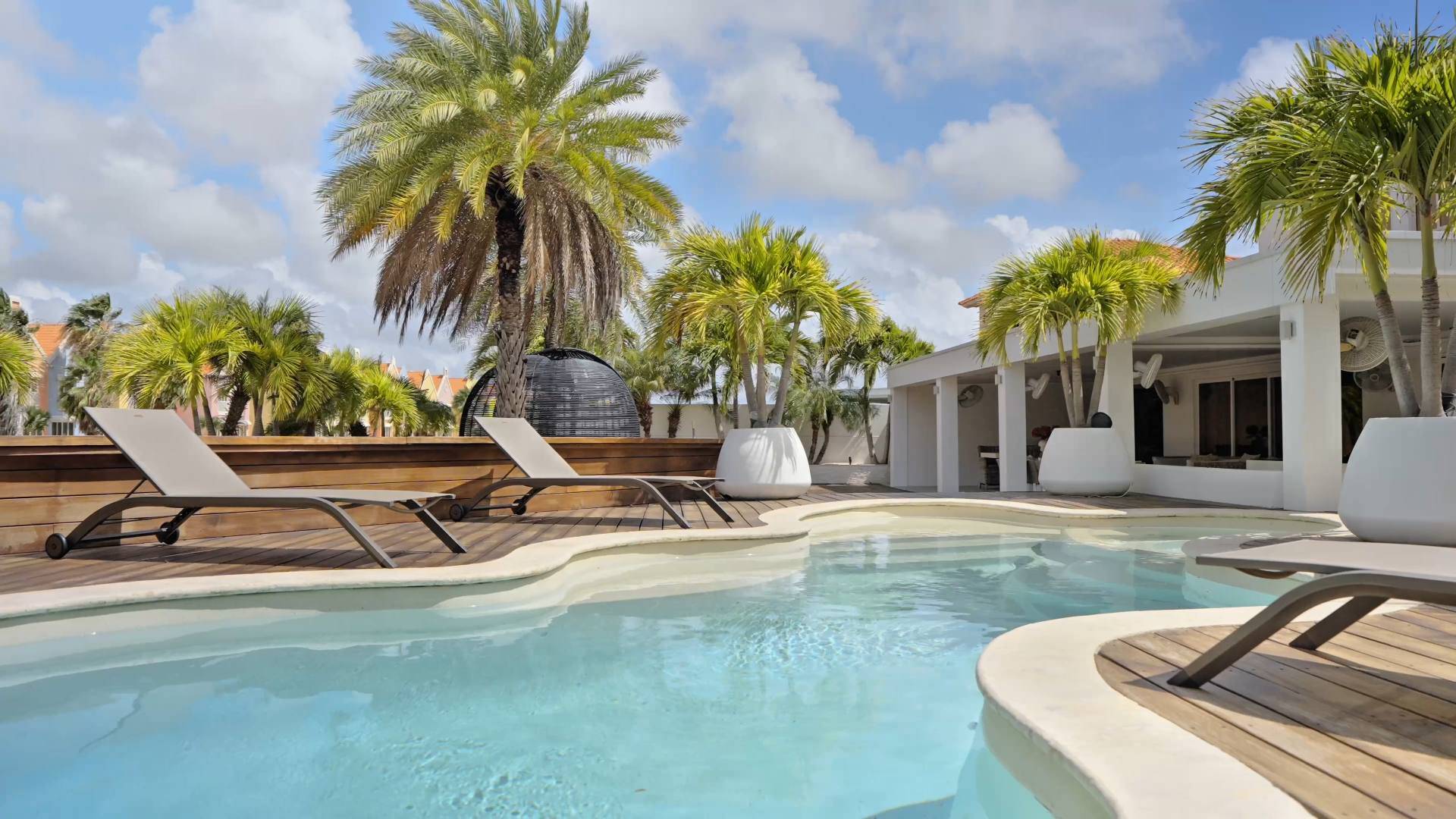
Renting on Bonaire
Renting a holiday home on Bonaire, made clear.
Villas, apartments and beach houses for a week, a month or a whole season. This is how a stay with us works, from the first request to the day you hand back the keys.
Booking
How do I book a home?
You send a request and we confirm. Nothing is charged on the website.
Pick your dates
Every home has a live calendar. Choose your arrival and departure and the price for those nights appears straight away, including any seasonal rate and, where one applies, a fee per extra guest.
Send a request
Tell us who is coming and anything we should know. A request is not a booking yet: we check the dates and come back to you personally, usually within one business day.
We confirm
Once we confirm, you receive the details of the stay and how to pay. Your booking is final when we have both agreed, not the moment you click.
Minimum stays. In the high season most homes ask for a longer minimum stay than in the low season. If the dates you pick fall short of a home’s minimum, the calendar says so before you send anything.
Prices
Why does the price change with the dates?
Bonaire has a high season, a mid season and a low season, and a home’s nightly rate follows them.
The price you see is per night for the home, for the number of guests included in that home. Some homes charge a fixed amount per extra guest per night, and children count as guests. Everything is in US dollars, the island’s currency.
The tourist tax and the nature fee are never part of the accommodation price, because you pay them to the island yourself. Both are explained below.
Staying a whole season? A holiday rental on Bonaire runs for at most 90 consecutive nights to the same household. Anything longer counts as a long-term lease, with different rules. Tell us your dates and we will explain what is possible.
Is anything not included in the price?
The tourist tax is one you pay directly, not something we add to your bill. Bonaire replaced its old room tax with a flat $75 per visitor per stay, paid online before you travel or at a kiosk at the airport or seaport. You get a QR code that’s valid for a month. It drops to $10 for residents of Aruba, Curaçao, Saba, Sint Eustatius and Sint Maarten, for island children, under-13s and cruise passengers. Doing it before you fly takes a couple of minutes and saves a queue.
The nature fee is separate, and good value. $40 per person covers both the marine park and Washington Slagbaai for a whole calendar year, so if you come twice in one year, you only pay once. You need it whether or not you dive, since it covers anyone entering the parks. Residents of Bonaire, Aruba, Curaçao, Sint Maarten, Sint Eustatius and Saba are exempt, as are children under 12.
On the island
What should I know before I arrive?
Flamingo International Airport is about 3 km south of Kralendijk, so most homes are minutes from the runway.
Everything is priced in US dollars. Dutch is the language of government, Papiamentu is what most people speak at home, and English is spoken widely: at the last count, three out of four residents speak it.
Tap water is drinking water. It is seawater made fresh by reverse osmosis and tested twice a week.
Electricity on Bonaire is expensive and has risen by about 60% in eighteen months, which is why island homes take air conditioning seriously. Use it in the room you are in and switch it off when you head out.
The trade wind blows almost always from the east and the sun is strong all year. The long-term average is 28 °C, with only 2.4 °C between the warmest and the coolest month (Flamingo Airport normals, 1971 to 2000).